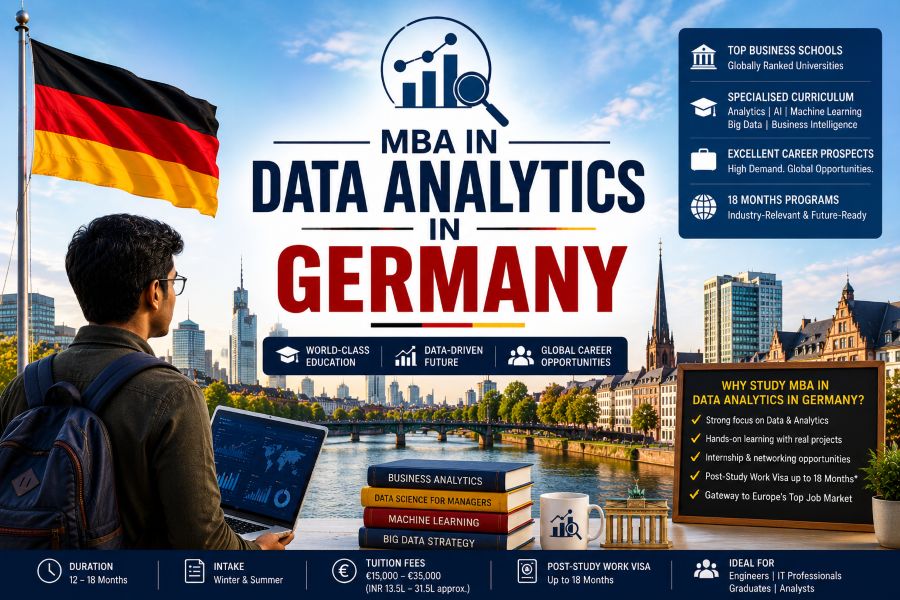

MBA Scholarships in Germany
Table of Contents
- Why Apply for MBA Scholarships in Germany?
- Types of MBA Scholarships in Germany
- DAAD EPOS Scholarship (Fully Funded)
- Deutschlandstipendium
- Heinrich Böll Foundation Scholarship
- University-Specific MBA Scholarships
- Eligibility Criteria for MBA Scholarships in Germany
- MBA Scholarship in Germany Application Timeline
- MBA Cost in Germany After Scholarships
- Author’s Final Thought
Germany is a great destination for Indian students for they can significantly reduce education expenses through a wide range of government-funded, university-specific, corporate-sponsored and merit-based scholarships.
The most prestigious funding opportunity like DAAD EPOS Scholarship, can cover tuition fees, living expenses, travel costs and health insurance. Alongside DAAD, scholarships like the Deutschlandstipendium, ESMT Berlin Fellowships, WHU Scholarships, and Munich Business School Awards help exceptional international students finance their MBA education.
Key Highlights of MBA Scholarships in Germany
Particular | Details |
Fully Funded Scholarships | DAAD EPOS |
Monthly Government Scholarship | Deutschlandstipendium (€300/month – ₹30,000 approx.) |
University Scholarships | ESMT Berlin, WHU, Munich Business School |
Scholarship Coverage | Tuition, Living Expenses, Insurance, Travel (varies) |
Eligible Students | International & Indian MBA Applicants |
Common Selection Criteria | Academic Merit, Leadership, Work Experience, SOP |
Best Time to Apply | 8–12 Months Before Intake |
This article explains the best MBA scholarships available in Germany in detail from eligibility requirements, funding amounts, application timelines and practical tips to maximise your chances of receiving financial aid.
Why Apply for MBA Scholarships in Germany?
MBA in Germany offers tuition free public universities, most internationally recognised MBA programs are offered by private business schools where tuition fees can be substantial. Scholarships are excellent to reduce financial burden and also gain academic excellence and leadership potential. Some major benefits include:
Reduce MBA tuition costs significantly through government and university-funded scholarships.
Receive monthly stipends that help cover accommodation, food, insurance, and transportation expenses.
Improve your overall return on investment by graduating with lower education debt.
Gain recognition from globally respected organisations such as DAAD and leading German business schools.
Access exclusive networking, mentoring, and leadership opportunities offered by scholarship providers.
Increase your profile among employers by earning competitive merit-based awards.
MBA Universities in Germany offer multiple scholarships that assist students with their academic life and helps with an excellent career as well.
Types of MBA Scholarships in Germany
Germany’s multiple funding options are largely dependent on applicants overall academic background, work experience and leadership achievements. There are numerous scholarships available for Indian students.
The table below compares the primary scholarship categories.
Scholarship Type | Funding Source | Best For |
Government Scholarships | DAAD, Deutschlandstipendium | Outstanding international students |
University Scholarships | ESMT, WHU, Munich Business School | Merit-based applicants |
Foundation Scholarships | Heinrich Böll, Konrad Adenauer | Students with leadership and social commitment |
DAAD EPOS Scholarship (Fully Funded)
German Academic Exchange Service (DAAD) administers one of the world's most prestigious scholarship programmes for international students. For eligible MBA and management-related postgraduate programs, the DAAD EPOS Scholarship can provide comprehensive financial support.
The table below summarises the benefits.
Benefit | Coverage | Approximate Value |
Monthly Living Stipend | Yes | €934/month (₹93,000 approx.) |
Tuition Fees | Fully Covered (Eligible Programs) | Varies |
Health Insurance | Included | Full Coverage |
Who Can Apply?
DAAD also provides travel allowances, research grants, and family benefits where applicable. Applicants generally need:
A recognised bachelor's degree.
Excellent academic performance.
Relevant professional work experience (often at least two years).
Strong motivation demonstrating future leadership potential.
Since EPOS scholarships are available only for selected programmes, students should verify eligibility through the official DAAD scholarship database before applying.
Deutschlandstipendium
The Deutschlandstipendium is Germany's national merit scholarship programme jointly funded by the German government and private organisations. Unlike many financial aid programmes, this scholarship is awarded primarily on academic excellence, leadership potential, and social commitment rather than financial need.
The table below highlights its key features.
Particular | Details | Approximate Value |
Monthly Stipend | €300/month | ₹30,000/month |
Duration | Usually One Academic Year | Renewable at some universities |
Eligibility | Academic Merit & Leadership | International students eligible |
Heinrich Böll Foundation Scholarship
The Heinrich Böll Foundation supports international postgraduate students who demonstrate outstanding academic achievements alongside strong social responsibility and leadership qualities.
The table below summarises the scholarship.
Benefit | Coverage | Eligibility |
Monthly Funding | €750+ (₹75,000+) | High academic performance |
Additional Allowances | Available in some cases | Depends on applicant profile |
Selection Criteria | Leadership & Social Engagement | International Master's students |
University-Specific MBA Scholarships
Many German business schools offer generous scholarships specifically for international MBA applicants. These awards are often based on academic excellence, diversity, professional achievements, leadership potential, or industry background.
ESMT Berlin Scholarships
ESMT Berlin offers some of Germany's most competitive MBA scholarships.
The table below highlights popular awards.
Scholarship | Coverage | Eligibility |
Women in Business Scholarship | Up to €7,500 (₹7.5 lakh) | Female MBA applicants |
BMW Group Change Maker Fellowship | Up to €45,000 (₹45 lakh) | Technology, Mathematics & Innovation background |
Merit Scholarships | Partial Tuition Waivers | Outstanding applicants |
The BMW Fellowship is among the most valuable MBA scholarships available in Germany for international students.
WHU – Otto Beisheim School of Management Scholarships
WHU provides several scholarships aimed at supporting exceptional international candidates.
The table below outlines major options.
Scholarship | Coverage | Eligibility |
Emerging Countries Scholarship | Partial Tuition | Applicants from developing economies |
Merit Scholarship | Tuition Reduction | Strong academic profile |
Leadership Scholarship | Partial Funding | Leadership achievements |
Munich Business School Scholarships
Munich Business School offers multiple scholarships encouraging diversity, innovation, and responsible leadership.
The table below summarises key opportunities.
Scholarship | Coverage | Focus Area |
Global Thinker Scholarship | Up to €4,000 (₹4 lakh) | International Outlook |
Responsible Leader Scholarship | Up to €4,000 (₹4 lakh) | Leadership & Sustainability |
Diversity Scholarship | Partial Tuition | Diverse Student Community |
Eligibility Criteria for MBA Scholarships in Germany
Each scholarship programme follows its own selection criteria. Applicants with excellent academic records, impactful work experience, leadership initiatives, and community involvement generally have the strongest chances of securing scholarships.
The table below summarises the common eligibility requirements.
Requirement | Typical Requirement | Notes |
Bachelor's Degree | Recognised undergraduate degree | Minimum academic performance varies |
MBA Admission | Admission offer or application | Required for most university scholarships |
Work Experience | 2–5 Years (Preferred) | Especially for MBA and DAAD EPOS |
English Proficiency | IELTS/TOEFL | As required by the university |
Leadership Profile | Strongly Preferred | Professional achievements, volunteering, entrepreneurship |
Statement of Purpose | Mandatory | Explaining career goals and scholarship motivation |
MBA Scholarship in Germany Application Timeline
Most funding opportunities have deadlines several months before the academic intake. For most September intakes, scholarship preparation should ideally begin during the previous year.
The table below provides a general scholarship timeline.
Stage | Recommended Timeline | Activity |
University Shortlisting | 12–15 Months Before Intake | Research MBA programs |
Scholarship Research | 10–12 Months Before Intake | Identify eligible scholarships |
University Applications | 8–10 Months Before Intake | Submit admission applications |
Scholarship Applications | 6–9 Months Before Intake | Apply for DAAD & university awards |
Admission Decision | 4–6 Months Before Intake | Receive offer letter |
Student Visa Process | 2–3 Months Before Intake | Apply after funding confirmation |
How to Apply for MBA Scholarships in Germany
The application process for MBA Scholarships in Germany should start well in advance with proper arrangements. Although every scholarship has its own process, the overall application journey remains similar like the follwoing:
Step 1: Choose Your MBA Program
Shortlist universities that offer scholarships relevant to your academic profile, career goals, and financial requirements.
Step 2: Review Scholarship Eligibility
Carefully check:
Nationality requirements
Academic criteria
Work experience requirements
Language requirements
Program eligibility
Step 3: Prepare Required Documents
Most scholarships require well-prepared supporting documents that showcase your achievements beyond academics.
Step 4: Submit University Application
Many university scholarships automatically consider applicants after admission, while others require separate scholarship applications.
Step 5: Apply for External Scholarships
Submit applications for scholarships like DAAD, Deutschlandstipendium, and foundation scholarships before their respective deadlines.
Step 6: Prepare for Interviews (if applicable)
Some scholarships conduct interviews to assess leadership potential, career vision, communication skills, and motivation.
H3: Documents Required for MBA Scholarships in Germany
Preparing documents early improves your application quality and reduces last-minute stress for applicants.
The table below lists the most commonly required documents.
Document | Purpose |
Academic Transcripts | Academic Evaluation |
Bachelor's Degree Certificate | Eligibility Verification |
MBA Admission Letter | University Confirmation |
Updated Resume/CV | Professional Profile |
Statement of Purpose | Scholarship Motivation |
Letters of Recommendation | Academic/Professional Evaluation |
IELTS/TOEFL Score | English Proficiency |
Passport | Identity Verification |
H2: Tips to Increase Scholarship Chances
MBA scholarships in Germany are highly competitive. Building a strong overall profile often matters more than simply having excellent grades.
Some proven strategies include:
Apply during the earliest scholarship rounds whenever possible.
Maintain a strong academic record throughout your bachelor's degree.
Highlight measurable leadership achievements rather than listing responsibilities.
Showcase community service, volunteering, entrepreneurship, or extracurricular activities.
Tailor every Statement of Purpose specifically to each scholarship.
Obtain recommendation letters from supervisors who know your professional strengths.
Clearly explain your long-term career goals and how the MBA aligns with them.
Apply to multiple scholarships simultaneously instead of relying on a single funding source.
Common Mistakes to Avoid
Many deserving applicants miss scholarship opportunities because of avoidable errors.
The most common mistakes include:
Applying after scholarship deadlines.
Submitting generic Statements of Purpose.
Ignoring scholarship-specific eligibility criteria.
Uploading incomplete documents.
Underestimating the importance of leadership experience.
Applying only to fully funded scholarships instead of combining multiple funding options.
Waiting for admission before researching scholarships.
Starting early and staying organised greatly improves your chances of success.
MBA Cost in Germany After Scholarships
Scholarships can substantially reduce the overall cost of pursuing an MBA in Germany.
The table below provides an approximate comparison.
Scholarship Type | Tuition Savings | Living Support |
DAAD EPOS | Up to 100% Tuition | Monthly stipend + insurance + travel |
Deutschlandstipendium | No Tuition Coverage | €300/month (₹30,000 approx.) |
ESMT Scholarships | Partial to Major Tuition Reduction | Varies |
WHU Scholarships | Partial Tuition Waiver | Limited |
Munich Business School Awards | Up to €4,000 (₹4 lakh) | Tuition Reduction |
Combining university scholarships with external funding can significantly reduce the financial burden for Indian students.
Author’s Final Thought
Germany offers some of the world's best MBA funding opportunities for international students. From fully funded government scholarships like DAAD EPOS to prestigious university awards offered by ESMT Berlin, WHU, and Munich Business School. Expert Tips for MBA Scholarships in Germany:
Begin researching scholarships at least one year before your intended intake.
Never depend on a single scholarship—apply for multiple funding opportunities.
Prioritise fully funded scholarships such as DAAD whenever eligible.
Tailor every scholarship essay instead of submitting generic applications.
Showcase leadership achievements using measurable outcomes.
Maintain consistent academic performance throughout your undergraduate studies.
Keep recommendation letters updated and personalised.
Track every scholarship deadline using a dedicated application calendar.
Read about popular MBA programs in Germany:
Book a free 1:1 counselling session with our experts today and start your academic journey in Germany.