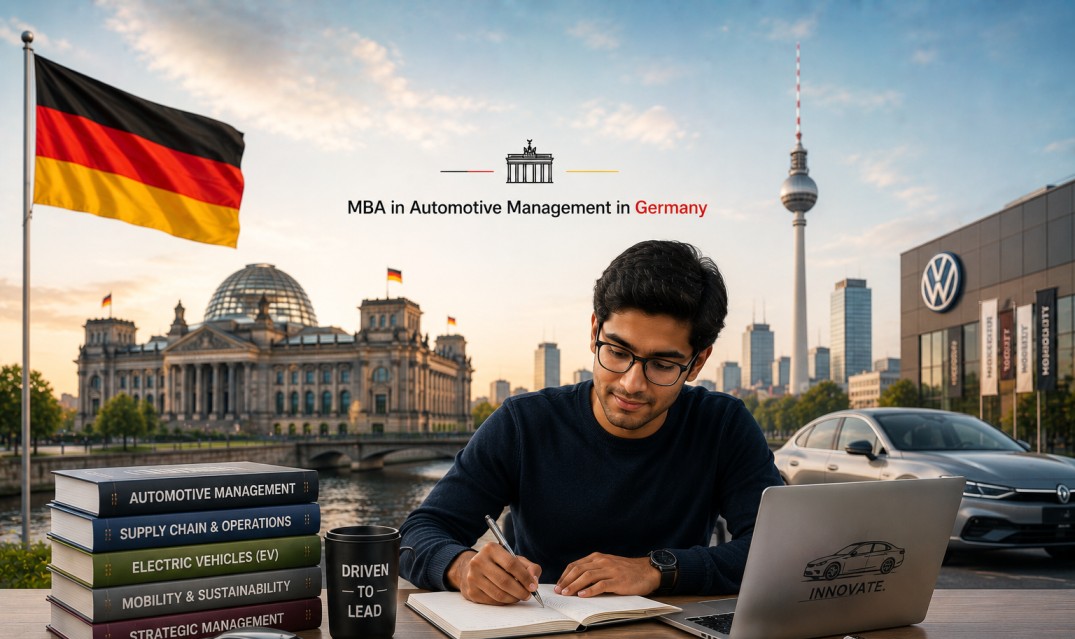
MBA in Automotive Management in Germany
Table of Contents
- Top Universities for MBA in Automotive Management in Germany
- Course Structure of MBA in Automotive Management in Germany
- Eligibility Requirements for MBA in Automotive Management in Germany
- Cost of MBA in Automotive Management in Germany
- Cost of Living for MBA in Automotive Management Students in Germany
- Scholarships for MBA in Automotive Management in Germany
- Intakes for MBA in Automotive Management in Germany
- Admission Process for MBA in Automotive Management in Germany
- Student Visa Requirements for MBA in Automotive Management in Germany
- Career Opportunities After MBA in Automotive Management in Germany
- Final Thoughts from Author
Pursuing an MBA in Automotive Management in Germany puts you at the heart of the global automotive industry. These specialised programs combine business management with automotive strategy, electric mobility, and supply chain management.
Germany is home to global automotive companies such as BMW, Mercedes-Benz, Volkswagen, Audi, Porsche, Bosch, and Continental, making it a leading destination for automotive management studies.
Most MBA programs take 1-2 years and prepare students for leadership careers across the automotive, mobility, EV, manufacturing, and consulting sectors.
The table below gives a quick overview of MBA in Automotive Management in Germany:
Parameter | Details |
Top Universities | Frankfurt School of Finance & Management, Mannheim Business School, WHU Otto Beisheim |
Course Type | MBA / Automotive or Mobility Management MBA |
Duration | 1-2 years |
Tuition Fees | €10,000-€45,000 (≈ INR 11 L-49 L) |
Living Cost | €900-€1,200/month (≈ INR 1 L-1 L) |
Blocked Account | €11,904/year (≈ INR 13 L) |
Work Rights | 140 full days / 280 half days/year |
Post-Study Stay | Up to 18 months |
Salary Range | €55,000-€90,000/year (≈ INR 60 L-98 L) |
Top Universities for MBA in Automotive Management in Germany
MBA in Automotive Management may be offered as a direct automotive or mobility-focused MBA, or as a general MBA with electives in innovation, operations, supply chain, and digital transformation.
Some of the best universities in Germany for MBA also offer management programs connected with Germany’s strong automotive, manufacturing, and mobility sectors.
The table below highlights Universities for MBA in Automotive Management:
Universities for MBA in Automotive Management in Germany | QS Global MBA Ranking 2026 |
Frankfurt School of Finance & Management | 40 |
Mannheim Business School | =46 |
WHU Otto Beisheim | 57 |
EU Business School | 101-110 |
HHL Leipzig | 151-200 |
Hochschule Bremen IGC | 301+ |
Course Structure of MBA in Automotive Management in Germany
MBA in Automotive Management in Germany combines core business education with automotive industry knowledge.
Students study leadership, strategy, finance, marketing, supply chain, production, innovation, and mobility business models.
Many programs also include applied projects, case studies, company visits, consulting projects, or a final thesis.
The table below explain Course Structure of MBA in Automotive Management:
Component | What You Study | Purpose |
Core MBA Modules | Strategy, finance, leadership | Build management base |
Automotive Core | Mobility, production, supply chain | Learn industry operations |
Digital Mobility | EVs, connected vehicles, MaaS | Understand future mobility |
Applied Projects | Case studies, company projects | Build practical exposure |
Thesis / Capstone | Research or business project | Final academic output |
Core Subjects in MBA in Automotive Management in Germany
Core subjects help students understand both business management and automotive industry challenges.
The course does not train you as an automotive engineer. Instead, it prepares you for management, strategy, product, supply chain, and operations roles in automotive and mobility companies.
Common subjects include:
Strategic Management
Corporate Finance
Automotive Marketing
Supply Chain Management
Production and Operations
E-Mobility Strategy
Digital Transformation
Innovation Management
Business Analytics
Mobility Services
International Business
Leadership and Change Management
Automotive Management Specializations in Germany
Automotive Management specialisations in Germany are closely aligned with the country's transition towards electric vehicles (EVs), connected mobility, automation, digital manufacturing, and sustainable production.
Students should choose a specialisation based on their academic background, work experience, and long-term career goals to build expertise in the automotive and mobility sector.
The table below lists Automotive Management specialisations:
Specialization | Best For |
E-Mobility Management | EV strategy and battery business |
Supply Chain and Logistics | Procurement and global operations |
Automotive Marketing | Sales, branding, aftersales |
Mobility Innovation | Shared mobility and MaaS |
Production Management | Manufacturing and plant operations |
Consulting and Strategy | OEM and supplier advisory roles |
Read More: MBA Courses in Germany
Eligibility Requirements for MBA in Automotive Management in Germany
To apply for MBA in Automotive Management in Germany, you usually need a recognised bachelor’s degree, relevant work experience, English proficiency, and a strong application profile.
Some universities may ask for GMAT or GRE, while others may waive it based on work experience.
The table below summarises the common Eligibility Requirements:
Requirement | Common Expectation |
Bachelor’s Degree | Recognised 3-4 year degree |
Background | Business, engineering, economics, technology |
Work Experience | 1-3 years preferred |
English Test | IELTS / TOEFL / PTE |
GMAT/GRE | Required or waivable |
Documents | CV, SOP, LORs, transcripts |
APS | Required for many Indian applicants |
Academic Requirements for MBA in Automotive Management in Germany
Students with backgrounds in engineering, business, commerce, economics, mechanical engineering, automotive engineering, industrial engineering, information technology (IT), or management are generally eligible for an MBA in Automotive Management.
However, the exact academic requirements vary by university, and some programs may also prefer applicants with relevant work experience.
You should prepare:
Bachelor’s degree certificate
Academic transcripts
Updated CV
Motivation letter or SOP
Letters of recommendation
English language score
GMAT/GRE, if required
APS certificate, if applicable
Work Experience and English Language Requirements
Most MBA programs prefer applicants with professional experience. For Automotive Management, experience in automotive, manufacturing, supply chain, consulting, sales, operations, engineering, or technology can make your profile stronger.
The table below shows common requirements:
Requirement | Common Range |
Work Experience | 1-3 years minimum |
IELTS Academic | 6.5-7.0 |
TOEFL iBT | 80-100 |
German Language | Not always required, but useful |
Interview | Required by some schools |
Note:
German language is not always required for English-taught MBA programs.
However, learning German can improve your chances for internships, part-time work, and full-time roles in automotive companies.
Also Read: MBA in Germany without GMAT
Cost of MBA in Automotive Management in Germany
The cost of Automotive Management MBA depends on the university type and program format.
Public universities and universities of applied sciences may be cheaper, while private business schools and executive programs usually charge higher tuition.
The table below gives estimated tuition fees for MBA in Automotive Management:
Expense Type | Euro Cost | INR Equivalent |
Tuition Fees | €10,000-€45,000 | ≈ INR 11 L-49 L |
Semester Contribution | €70-€430/semester | ≈ INR 8,000-47,000 |
Living Cost / Year | €10,800-€14,400 | ≈ INR 12 L-16 L |
Blocked Account | €11,904/year | ≈ INR 13 L |
Visa Fee | €75 | ≈ INR 8,000 |
Cost of Living for MBA in Automotive Management Students in Germany
MBA students should budget for living expenses, depending on the city and lifestyle. Munich and Stuttgart are usually expensive because they are major automotive and industrial hubs.
Smaller cities such as Ingolstadt, Bremen, and Leipzig can be more affordable.
The table below provides an estimated monthly budget:
Expense | Monthly Cost | INR Equivalent |
Rent and Utilities | €400-€900 | ≈ INR 44,000-98,000 |
Food and Groceries | €200-€350 | ≈ INR 22,000-38,000 |
Health Insurance | €120-€150 | ≈ INR 13,000-16,000 |
Transport | €50-€100 | ≈ INR 5,000-11,000 |
Personal Expenses | €100-€200 | ≈ INR 11,000-22,000 |
Scholarships for MBA in Automotive Management in Germany
Scholarships for MBA in Automotive Management may come from universities, business schools, DAAD, foundations, and private funding partners.
MBA scholarships are competitive, so students should apply early and show strong academics, leadership, work experience, and clear career goals.
The table below highlights MBA scholarships in Germany for Automotive Management:
Scholarship Type | Benefit | Best For |
DAAD Scholarships | Monthly support, varies by program | International students |
Deutschlandstipendium | €300/month (≈ INR 33,000) | High-achieving students |
University Scholarships | Partial tuition support | MBA applicants |
Women in Business Awards | Varies | Women MBA candidates |
Merit Scholarships | Partial fee reduction | Strong profiles |
Intakes for MBA in Automotive Management in Germany
An MBA in Automotive Management is commonly offered in the Winter Intake, with classes starting around September or October.
Some private or executive programs may also offer Summer Intake or rolling admissions.
The table below shows common intake patterns:
Intake | Classes Usually Begin | Common Deadline |
Winter Intake | September / October | March-July |
Summer Intake | March / April | October-January |
Rolling Intake | Varies | Private schools only |
Note: Start preparing 9-12 months before your target intake because APS, English tests, SOP, LORs, and visa appointments can take time.
Admission Process for MBA in Automotive Management in Germany
The admission process for MBA in Automotive Management in Germany is manageable if you start early.
Most universities accept applications through their own online portal, while some may use uni-assist for international document checks.
Follow these steps to apply:
Shortlist universities and MBA programs based on curriculum, automotive specialisation, industry partnerships, tuition fees, location, and career outcomes.
Check the admission requirements, including academic qualifications, work experience, English language proficiency, GMAT/GRE (if required), and application deadlines.
Prepare for English language tests such as IELTS or TOEFL, and GMAT/GRE if your chosen university requires them.
Complete APS verification if you completed your previous education in India, as it is generally required for the German student visa process.
Prepare all required documents, including academic transcripts, degree certificates, CV, Statement of Purpose (SOP), Letters of Recommendation (LORs), passport, and work experience certificates (if applicable).
Submit your application through the university's official portal or uni-assist, depending on the institution's application process.
Attend an interview or assessment, if shortlisted, as some business schools conduct interviews to evaluate your academic background, professional experience, and career goals.
Accept the admission offer and pay the required enrolment or tuition deposit, if applicable.
Arrange your blocked account, health insurance, accommodation, and other financial documents required for your visa application.
Apply for a German student visa well in advance to allow sufficient time for document verification and visa processing before your course begins.
Student Visa Requirements for MBA in Automotive Management in Germany
To study MBA in Automotive Management in Germany, non-EU students usually need a German National Student Visa.
Students need an admission letter, proof of funds, health insurance, academic documents, language proof, and a valid passport.
The table below summarises the major visa requirements:
Requirement | Details |
Admission Letter | From a recognised German institution |
Proof of Funds | €11,904/year (≈ INR 13 L) |
Health Insurance | Mandatory |
APS Certificate | Required for many Indian applicants |
Language Proof | IELTS / TOEFL / German test |
Visa Fee | €75 (≈ INR 8,000) |
Passport | Valid passport required |
Note: After graduation, non-EU graduates can apply for a residence permit valid for up to 18 months to search for qualified employment.
Career Opportunities After MBA in Automotive Management in Germany
MBA in Automotive Management can lead to roles in automotive strategy, product management, supply chain, consulting, EV operations, sales, and mobility startups.
Germany’s automotive sector offers strong job opportunities in Germany after MBA through OEMs, Tier-1 suppliers, logistics firms, consulting companies, and technology providers.
The MBA salary in Germany depends on the role, employer, city, industry, and work experience.
The table below shows common roles and salary ranges after MBA in Automotive Management:
Job Role | Salary Range | INR Equivalent |
Automotive Product Manager | €60,000-€85,000 | ≈ INR 65 L-93 L |
Supply Chain Manager | €55,000-€85,000 | ≈ INR 60 L-93 L |
Operations Manager | €55,000-€80,000 | ≈ INR 60 L-87 L |
Strategy Consultant | €60,000-€90,000 | ≈ INR 65 L-98 L |
Business Development Manager | €55,000-€85,000 | ≈ INR 60 L-93 L |
Final Thoughts from Author
MBA in Automotive Management in Germany is a practical choice if you want to build a career in mobility, EVs, automotive strategy, supply chain, or manufacturing leadership.
Germany gives you access to one of the strongest automotive ecosystems in the world.
You should also compare tuition, location, industry links, internship exposure, German language needs, and post-study work options.
Still have questions about Best Courses to Study in Germany? Book a free 1:1 counselling session With our study abroad experts for personalised guidance.