
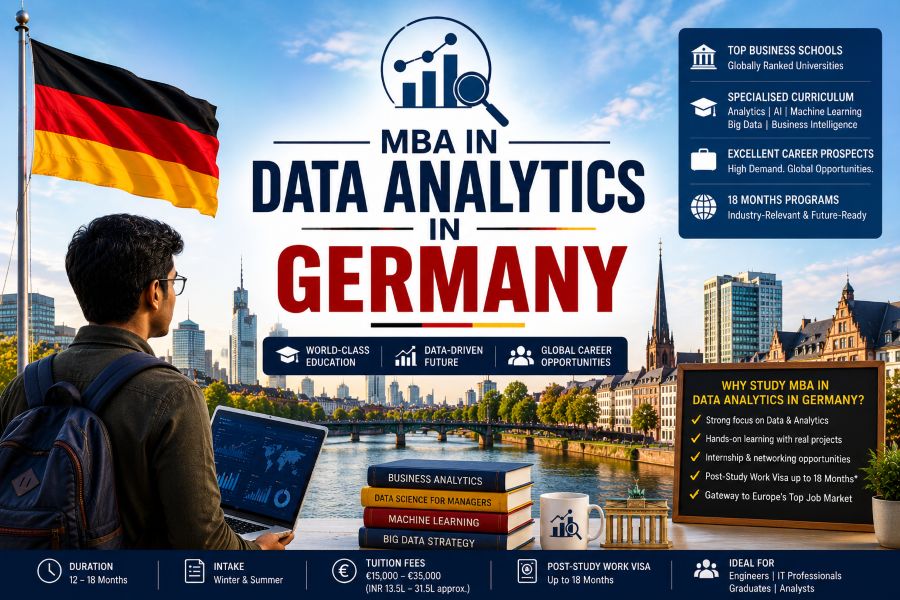
MBA in Data Analytics in Germany
Table of Contents
- Top MBA in Data Analytics Colleges in Germany
- MBA in Data Analytics Syllabus in Germany
- Cost for studying MBA in Data Analytics in Germany
- Scholarships for MBA in Data Analytics in Germany
- Eligibility for MBA in Data Analytics in Germany
- Admission Requirements for MBA in Data Analytics in Germany
- Application Process for MBA in Data Analytics in Germany
- MBA in Data Analytics Jobs in Germany
- Author's Final Thoughts
MBA in Data Analytics Germany blends core business strategy with hands-on technical skills like Python, R, SQL and machine learning rather than treating them as separate tracks. Programs run for 1.5 to 2 years and are taught entirely in English, which makes them accessible without requiring German proficiency at entry. Tuition varies by institution type: public universities charge little to nothing, while private business schools range from approx. €10,000 to €22,000 annually.
Key Highlights: MBA in Data Analytics Germany
Particular | Details |
Programme duration | 1.5-2 years (typically 3-4 semesters) |
Language of instruction | English |
Public university tuition | Free to low-cost (semester contribution only) |
Private university tuition | €10,000-€22,000/year (INR 10.97L-24.13L) |
Core skills covered | Python, R, SQL, machine learning, business analytics |
Post-study work visa | 18 months |
Average data analyst salary in Germany (2026) | €51,000-€71,000/year (INR 55.9L-77.8L) |
This blog covers top colleges offering MBA in Data Analytics in Germany, syllabus, tuition and living costs, scholarships, eligibility, admissions and the career outcomes graduates can expect in data analytics jobs in Germany
Top MBA in Data Analytics Colleges in Germany
ESB Business School's programme leans heavily on applied empirical methods and machine learning rather than generic business analytics, which makes it a strong fit for applicants who want a genuinely technical MBA rather than a business degree with a few analytics electives. Steinbeis carries a higher price tag but compresses the programme into a single upfront fee across three semesters, while Macromedia and GISMA sit at a more moderate, similarly priced tier.
The table below highlights recognized MBA in Data Analytics colleges in Germany :
University | Programme | Approx. Tuition |
ESB Business School (Reutlingen University) | MBA International Management – Data Analytics and Decision Making | Public university fees (semester contribution only) |
Steinbeis University (Berlin) | MBA in Management Excellence (Data Analytics & AI) | €21,800 total for 3 semesters (INR 23.91L) |
Macromedia University of Applied Sciences (Munich/Berlin) | MBA Data Analytics (3 semesters) | €10,000-€15,000/year (INR 10.97L-16.46L) |
GISMA University of Applied Sciences (Berlin) | MBA with technical business analytics modules | €10,000-€15,000/year (INR 10.97L-16.46L) |
Technical University of Munich (Selected Analytics Programmes) | Semester Contribution | Munich |
MBA in Data Analytics Syllabus in Germany
The curriculum is built to sit at the intersection of management and technical data work, rather than favouring one over the other.
Core business modules: Strategic management, corporate finance, marketing analytics, operations management
Technical/analytics modules: Python and R programming, SQL and database management, statistical modelling, machine learning fundamentals
Applied modules: Business intelligence tools (Power BI, Tableau), predictive analytics, big data frameworks
Capstone/consulting project: A real business problem solved using data-driven methods, often with an industry partner
This structure is precisely why MBA in Data Analytics in Germany appeals to candidates who want to move into analytics leadership roles rather than staying purely technical, the business modules build the case for data-driven decisions, while the technical modules build the ability to actually produce them.
Cost for studying MBA in Data Analytics in Germany
Germany offers MBA programs for almost every budget. Total cost depends heavily on whether you choose a public or private institution, since the gap between the two is far wider here.
The table below compares public and private universities for MBA in Data Analytics in Germany:
University Type | Approx. Annual Tuition |
Public universities (e.g., ESB Business School) | Semester contribution only, typically €150-€350 (INR 16,455-38,395) |
Private universities (Steinbeis, Macromedia, GISMA) | €10,000-€22,000/year (INR 10.97L-24.13L) |
Living Expenses
Living costs vary depending on the city you choose. Munich and Frankfurt are the most expensive, while cities like Leipzig, Dresden and Magdeburg are considerably more affordable.
Below is an estimated monthly student budget.
Expense | Approx. Monthly Cost |
Accommodation | €350-€600 (INR 38,395-65,820) |
Food | €180-€250 (INR 19,746-27,425) |
Health insurance | €140 (INR 15,358) |
Transportation | Often included in semester tickets |
Personal expenses | €120-€180 (INR 13,164-19,746) |
Overall monthly living costs typically range between €900-€1,100 (INR 98,730-1.21 lakh), depending on the city, in addition to whichever tuition tier you choose.
Scholarships for MBA in Data Analytics in Germany
Scholarships can meaningfully offset the cost of a private-university MBA in Data Analytics in Germany. Since MBA-specific funding is limited, many students combine a partial scholarship with an education loan to cover a private-university programme.
Here are some MBA scholarships in Germany:
Scholarship | Coverage | Eligibility |
DAAD Scholarships | Monthly stipend, primarily for eligible postgraduate and research-oriented programmes | Outstanding academic record and relevant work experience |
Deutschlandstipendium | €300/month (INR 32,910/month), merit-based, awarded by individual universities | Academic excellence and extracurricular achievements |
University-specific merit scholarships | Partial tuition waivers at select private schools like Steinbeis, Macromedia, and GISMA | Partner university exchange programmes |
Early application discounts | Reduced tuition for applicants who apply well ahead of the deadline | Sustainability and social leadership |
Eligibility for MBA in Data Analytics in Germany
Admission requirements are broadly consistent across German business schools offering this programme, though specific GPA and work-experience expectations vary by institution.
Students should meet the following eligibility criteria before applying.
Requirement | Typical Criteria |
Bachelor's degree | Recognised 3- or 4-year degree, any discipline |
Work experience | Often 1-3 years preferred, though some programmes accept fresh graduates |
English proficiency | IELTS 6.0-6.5 or TOEFL equivalent |
GMAT/GRE | Optional or waived at most private universities |
Quantitative aptitude | Preferred, given the technical nature of the coursework |
Admission Requirements for MBA in Data Analytics in Germany
Candidates are required to submit a set of documents and transcripts for verification purposes. The following are some commonly required documents :
Requirement | Details |
Academic transcripts | Bachelor's degree certificate and mark sheets |
Statement of Purpose (SOP) | Explaining motivation for combining an MBA with data analytics |
CV/Resume | Highlighting relevant academic or work experience |
Letters of recommendation | Usually 1-2, academic or professional |
English proficiency proof | IELTS/TOEFL scorecard |
Interview | Required by several private universities, including Steinbeis and GISMA |
Application Process for MBA in Data Analytics in Germany
Most private universities offering this programme run a more direct, university-specific application process rather than a centralized platform.
Shortlist universities based on programme focus, tuition, and campus location.
Prepare academic transcripts, CV, SOP, and recommendation letters.
Take IELTS/TOEFL if you don't already have a valid score.
Submit your application directly through the university's admissions portal.
Attend an admissions interview if required.
Accept your offer and arrange proof of funds for your visa application.
Apply for your German student visa.
Student Visa Process for Germany
Once you have an admission offer, the German student visa becomes the next essential step.
Requirement | Details |
Admission letter | From your chosen university |
Blocked account | €11,904/year (INR 13.06 lakh) |
Health insurance | Mandatory |
Passport | Valid throughout your study period |
Visa fee | €75 (INR 8,228) |
Visa processing typically takes 4-12 weeks, so apply as soon as your documents are ready to avoid missing your intake.
MBA in Data Analytics Jobs in Germany
Germany's data analytics jobs in Germany market is genuinely strong: the country faces a shortage of over 106,000 unfilled IT and digital roles and MBA graduates who combine business acumen with technical analytics skills are well positioned to fill leadership-track versions of these roles rather than purely technical ones.
The table below presents MBA in Data Analytics salary and job roles:
Job Role | Average Annual Salary (2026) |
Data Analyst | €51,000-€71,000 (INR 55.9L-77.8L) |
Senior Data Analyst | €68,875-€88,000 (INR 75.5L-96.5L) |
Data Scientist | €58,000-€77,750 (INR 63.6L-85.3L) |
Analytics Manager/Lead | €70,500-€99,000 (INR 77.3L-1.09Cr) |
MBA in data analytics salary in Germany sits above a standalone technical data analyst's pay, the business training is what justifies the premium over a pure technical hire.
Top Recruiters
The following companies hire graduates for Data analytics jobs in Germany:
Employer | Sector | Common Roles |
SAP | Technology | Business analytics, product strategy |
Siemens | Industrial technology | Data-driven operations, digital transformation |
Deutsche Bank | Banking & finance | Risk analytics, business intelligence |
Bosch | Manufacturing | Data-driven operations, process optimisation |
Allianz | Insurance | Risk and data analytics |
Deloitte, PwC, KPMG, Accenture | Consulting | Data and analytics consulting |
Author's Final Thoughts
MBA in Data Analytics Germany offers a genuinely practical middle ground between a traditional MBA and a technical data science degree, backed by strong salary data and a real shortage of skilled analytics talent in the German job market. Choosing between public affordability and private-university networking depends on your budget and career timeline more than on programme quality alone
If your goal is to build a career in consulting, technology, product management, finance or business intelligence, Germany provides exceptional opportunities with attractive salaries and long-term career prospects.
Selecting the right university, preparing a strong application and developing analytical as well as German language skills will only improve your ROI. For further guidance, connect on a 1:1 session with our study abroad experts.
Frequently Asked Questions
It depends on your goal. An MBA suits candidates aiming for analytics leadership, consulting, or strategy roles, while a Master's in Data Science better suits those targeting deeply technical, individual-contributor data science positions.
Yes, most programmes accept candidates from any undergraduate discipline, though a comfort with quantitative reasoning helps considerably once the technical modules like Python, R, and machine learning begin in the second semester.
Many programmes prefer 1-3 years of experience, but several private universities, including Macromedia and GISMA, accept strong fresh graduates directly from their Bachelor's degree without requiring prior work history.
Public options like ESB Business School cost far less upfront, but private programmes like Steinbeis often offer faster networking access and smaller cohorts, which can matter more for MBA-level career switching than the tuition difference alone.
Yes, generally. German MBA degrees are recognised across the EU and by multinational employers everywhere, though specific recruiter perception can vary somewhat by the university's regional reputation and industry ties.
No, most institutions offering an MBA in Data Analytics in Germany either waive the GMAT entirely or make it optional, particularly for candidates with relevant work experience or a strong quantitative academic background.
Private universities like Steinbeis, Macromedia, and GISMA typically run smaller cohorts of 20-40 students per intake, while public university programmes may have larger class sizes depending on the specific department.
Yes, several graduates pursue certifications or short specialised courses in AI, deep learning, or cloud analytics platforms after their MBA to sharpen their technical edge for more senior analytics roles.
Most include a capstone consulting project with an industry partner rather than a formal internship, though some universities also offer optional internship placements alongside the coursework for genuinely interested students.
Admission is moderately competitive rather than extremely selective, with strong academic transcripts, a clear SOP connecting your background to data analytics, and (where required) a solid interview generally sufficient for well-prepared applicants.
The 18-month post-study work visa allows you to search broadly within your qualification area, so many graduates start in adjacent roles like business analyst or consultant before moving into a dedicated analytics position.