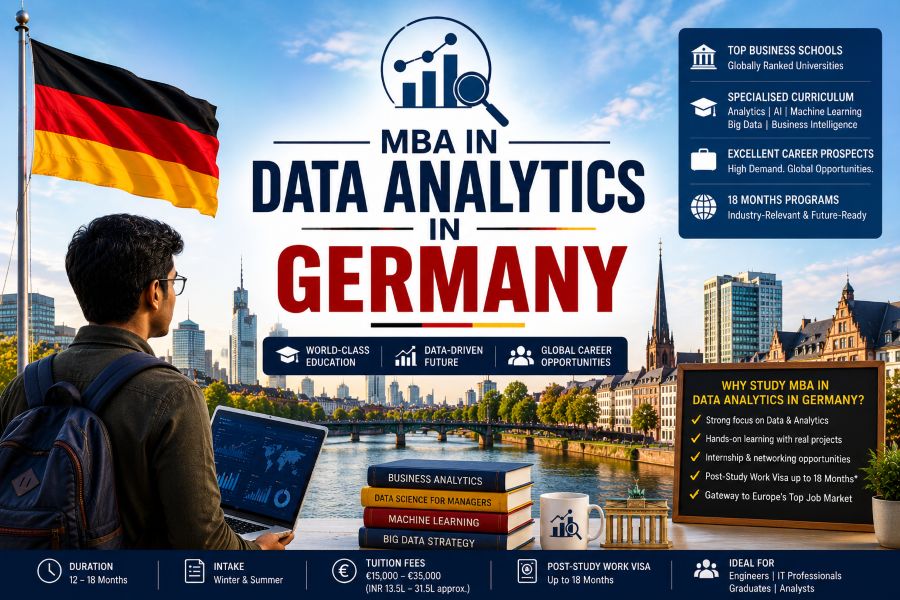

Eligibility Criteria for MBA in Germany
Table of Contents
- Academic Eligibility Criteria for MBA in Germany
- Requirements for an MBA in Germany
- Work Experience Eligibility Criteria for MBA in Germany
- GMAT and GRE Eligibility Criteria for MBA in Germany
- Language Test Eligibility Criteria for MBA in Germany
- APS Certificate Eligibility Criteria for MBA in Germany
- University-wise Eligibility Criteria for MBA in Germany
- Document Requirements for the Eligibility Criteria for MBA in Germany
- Admission Timeline for Meeting the Eligibility Criteria for MBA in Germany
- Application Process to Meet the Eligibility Criteria for MBA in Germany
- Reasons for Rejections after Eligibility Criteria for MBA in Germany is met
- Author's Final Thoughts
Germany has emerged as one of the most attractive study destinations for Indian professionals seeking an internationally recognised MBA degree. With world-class business schools, comparatively affordable tuition fees, strong industry connections, and excellent post-study work opportunities, pursuing MBA in Germany offers significant long-term career value.
For Indian applicants targeting Fall 2026, Spring 2027, or later intakes, understanding the eligibility criteria for MBA in Germany is essential before beginning the application process. In particular, obtaining an APS Certificate for Germany, preparing strong application documents and understanding the visa application process for Germany should be prioritized early.
Key Highlights
Requirement | Typical Criteria |
Bachelor's Degree | Recognised 3–4 year undergraduate degree |
Academic Performance | Equivalent to German GPA 2.5 or better |
Work Experience | Usually 2–5 years |
GMAT | 600–650+ preferred (varies by university) |
GRE | Accepted by many universities |
IELTS | 6.5–7.0 |
TOEFL iBT | 90–100 |
APS Certificate | Mandatory for Indian applicants |
German Language | Usually not mandatory for English-taught MBA programmes, but B1–B2 recommended for jobs |
Student Visa | German National Student Visa |
This guide explains the complete eligibility criteria for MBA in Germany, specifically for Indian students planning their MBA journey.
Academic Eligibility Criteria for MBA in Germany
Academic qualifications form the foundation of every MBA application. German universities carefully evaluate your undergraduate education to determine whether it meets their academic standards.
While requirements vary across institutions, most MBA programmes expect applicants to possess a recognised bachelor's degree and a satisfactory academic record.
Bachelor's Degree Requirement
Most German universities accept bachelor's degrees obtained from recognised Indian institutions.
Commonly accepted qualifications include:
Bachelor of Technology (B.Tech)
Bachelor of Engineering (B.E.)
Bachelor of Business Administration (BBA)
Bachelor of Commerce (B.Com)
Bachelor of Science (B.Sc.)
Bachelor of Arts (B.A.)
Other recognised equivalent degrees
3-Year vs 4-Year Degrees
Many private universities and business schools accept a 3-year Indian bachelor's degree. However, certain public universities prefer qualifications equivalent to 210 ECTS credits, which often translates to a 4-year degree.
Applicants with a 3-year degree are sometimes required to demonstrate additional academic achievements or relevant professional experience.
Minimum Academic Performance
Although German universities do not have a universal percentage requirement, competitive MBA programmes generally prefer candidates with consistent academic performance.
Minimum Academic performance required for MBA in Germany:
Institution Type | Recommended Academic Performance |
Public Universities | German GPA equivalent of 2.5 or better |
Private Universities | Flexible depending on work experience |
Top Business Schools | Strong academic consistency throughout undergraduate studies |
Requirements for an MBA in Germany
MBA admissions in Germany follow a holistic evaluation process. Instead of focusing solely on marks, admissions committees assess whether an applicant can contribute effectively to classroom discussions, group projects, and leadership-focused learning environments.
The major requirements for an MBA in Germany typically include:
Requirement | Typical Expectation |
Recognized Bachelor's Degree | Mandatory |
Professional Work Experience | 2–5 years |
GMAT/GRE | Preferred or mandatory depending on university |
English Language Test | IELTS/TOEFL/PTE |
Updated Resume | Required |
Statement of Purpose | Required |
Letters of Recommendation | Min. 2 |
APS Certificate | Mandatory for Indian students |
Student Visa | Required after admission |
Top business schools often place additional emphasis on:
Leadership potential
Career progression
International exposure
Managerial achievements
Communication skills
Interview performance
Work Experience Eligibility Criteria for MBA in Germany
Unlike many master's programmes, MBA programmes in Germany generally expect applicants to have prior work experience. Business schools prefer experienced professionals because MBA classrooms are designed around discussions, real-world case studies, and peer learning.
Typical Work Experience Requirement:
MBA Programme | Preferred Experience |
General MBA | 2–3 years |
Competitive Global MBA | 3–5 years |
Top-ranked Business Schools | 4–7 years |
Executive MBA | 5–10+ years |
GMAT and GRE Eligibility Criteria for MBA in Germany
Top business schools such as ESMT Berlin, Mannheim Business School, WHU – Otto Beisheim School of Management and Frankfurt School often consider GMAT/GRE scores during admissions.
General Expectations:
Institution | GMAT Requirement |
ESMT Berlin | 600–650+ preferred |
Mannheim Business School | 600–650+ recommended |
Frankfurt School | Preferred |
WHU – Otto Beisheim | Recommended |
Many Private Universities | Optional or waived |
A GMAT score around 600–650 or above is generally considered competitive for leading German MBA programmes, although admissions decisions are never based solely on test scores. Applicants with significant managerial experience may qualify for GMAT waivers at certain institutions.
Language Test Eligibility Criteria for MBA in Germany
Most MBA programmes in Germany are taught entirely in English. Therefore, applicants must demonstrate English language proficiency through recognised tests.
Accepted English Tests
Test | Typical Minimum Score |
IELTS Academic | 6.5–7.0 |
TOEFL iBT | 90–100 |
PTE Academic | 58–65 |
Duolingo English Test | Accepted by selected universities |
Some universities may waive English test requirements if your previous education was completed in English.
German Language Expectations
For English-taught MBA programmes:
German language proficiency is generally not required for admission.
Learning German before arrival is highly recommended.
A2–B1 proficiency helps with daily life.
B2–C1 proficiency significantly improves job opportunities after graduation.
APS Certificate Eligibility Criteria for MBA in Germany
The Academic Evaluation Centre (APS India) verifies the authenticity of educational qualifications issued by Indian institutions. The APS certificate has become a key requirement for Indian students applying to German universities and for German student visa applications.
APS Requirement Overview:
APS Requirement | Details |
Applicable To | Indian applicants |
Issuing Authority | Academic Evaluation Centre (APS India) |
Purpose | Verification of academic documents |
Processing Time | Approximately 4–8 weeks (may vary) |
Application Mode | Online through APS India |
Required Before | University admission and student visa application |
Typical APS documents include:
Passport
Class 10 marksheet
Class 12 marksheet
Bachelor's transcripts
Degree certificate
Passport photographs
APS application form
Fee payment proof
University-wise Eligibility Criteria for MBA in Germany
Although the overall eligibility criteria for MBA in Germany remain similar, admission expectations vary across public universities, private universities, and globally ranked business schools.
Compare the general admission expectations across different institution types.
Criteria | Public Universities | Private Universities | Top Business Schools |
Academic Profile | Strong emphasis | Flexible | Highly competitive |
Work Experience | 2–5 years | 1–3 years | 3–7 years |
GMAT | Often preferred | Frequently waived | Strongly recommended |
English Test | Required | Required | Required |
Document Requirements for the Eligibility Criteria for MBA in Germany
German universities place considerable emphasis on complete and accurate documentation. The following documents are commonly required while applying for an MBA in Germany.
Document |
Passport |
Bachelor's Degree Certificate |
Academic Transcripts |
APS Certificate |
Resume/CV |
Statement of Purpose (SOP) |
Letters of Recommendation (2) |
IELTS/TOEFL Scorecard |
GMAT/GRE Scorecard (if applicable) |
Work Experience Certificate |
Passport-sized Photographs |
Admission Timeline for Meeting the Eligibility Criteria for MBA in Germany
Meeting the eligibility criteria for MBA in Germany is only one part of the admission journey. Applying at the right time ensures enough room for APS verification, university processing, scholarships, and visa approval.
The timeline below is ideal for Indian students planning upcoming Fall 2026 or Spring 2027 admissions:
Timeline | Activity |
10–12 months before intake | Shortlist universities and begin GMAT/IELTS preparation |
8–10 months before intake | Apply for APS Certificate |
7–9 months before intake | Prepare SOP, CV and LORs |
6–8 months before intake | Submit university applications |
4–6 months before intake | Receive admission decisions |
2–3 months before intake | Arrange finances and accommodation |
1–2 months before intake | Apply for German student visa |
Application Process to Meet the Eligibility Criteria for MBA in Germany
Applying for an MBA in Germany requires careful planning and attention to detail. Following a structured application process improves your chances of receiving admission offers from multiple universities.
Follow these steps:
Research suitable MBA programmes.
Check admission requirements.
Obtain the APS Certificate.
Take IELTS/TOEFL and GMAT/GRE if required.
Prepare SOP, CV and recommendation letters.
Submit online applications.
Attend interviews.
Receive admission offers.
Arrange financial proof.
Complete the visa application process for Germany.
Student Visa Requirements after Meeting Eligibility Criteria for MBA in Germany
After receiving admission, Indian students must apply for a German National Student Visa.
The following documents are usually required for the German National Student Visa.
University admission letter
APS Certificate
Passport
Financial proof
Health insurance
Visa application form
Academic documents
Passport photographs
Germany also allows graduates of recognised German universities to remain in the country for up to 18 months after graduation to search for suitable employment, making it one of the most attractive post-study destinations for international students.
Reasons for Rejections after Eligibility Criteria for MBA in Germany is met
Even if you meet all eligibility requirements, admission is never guaranteed.
Common reasons for rejection include:
Weak Statement of Purpose
Generic recommendation letters
Limited leadership experience
Poor interview performance
Inconsistent academic history
Lack of career clarity
Weak professional impact
Missing documents
Late APS application
Applying only to highly competitive universities
Author's Final Thoughts
Understanding the eligibility criteria for MBA in Germany early can significantly improve your chances of admission. While academic qualifications remain important, German business schools also place considerable emphasis on professional experience, leadership potential, and career vision.
For Indian students, obtaining the APS Certificate for Germany, preparing a compelling application, and completing the visa application process for Germany on time are critical steps. If you are targeting Fall 2026 or later intakes, start preparing at least 10–12 months in advance. A strong profile, well-prepared documentation, and strategic university selection can help you secure admission to some of Germany's most respected MBA programmes.
Book a 1:1 session with our study abroad experts for further guidance
Frequently Asked Questions
Yes, many universities consider applicants with academic or career gaps if they can provide a valid explanation. Use your SOP to explain the gap constructively and highlight any skills, certifications, freelance work, or professional development activities completed during that period.
No, MBA programmes in Germany welcome applicants from engineering, IT, healthcare, science, humanities, and commerce backgrounds. Admissions committees often value diverse perspectives, provided you demonstrate leadership potential, career progression, and a strong motivation for pursuing management education.
Absolutely. Certifications such as PMP, CFA, ACCA, Six Sigma, AWS, SAP, Digital Marketing, or Data Analytics can strengthen your profile. They demonstrate commitment to continuous learning and may help offset weaker academic performance in some cases.
International experience is not mandatory, but it can significantly improve your application. Exposure to global teams, overseas projects, cross-cultural environments, or international clients demonstrates adaptability and leadership qualities that many German business schools appreciate.
Extracurricular activities can positively impact your application, especially if they demonstrate leadership, teamwork, social responsibility, entrepreneurship, or community engagement. Universities prefer well-rounded candidates who can contribute beyond academics and professional experience.
Yes, involvement in a family business is generally accepted as professional experience if you held defined responsibilities and contributed to business growth, operations, strategy, sales, finance, or management. Proper documentation and measurable achievements are important.
Many scholarships assess more than academic performance. Leadership experience, social impact, professional achievements, and future career objectives often play a significant role. A strong overall profile can improve both admission and scholarship opportunities.
No, career transitions are one of the primary reasons professionals pursue an MBA. Universities often welcome candidates seeking to move into consulting, finance, product management, entrepreneurship, or leadership positions, provided they clearly explain their goals.
Yes. Self-employed professionals, consultants, and freelancers can apply if they can demonstrate business activities, client projects, revenue generation, leadership responsibilities, and relevant professional achievements through supporting documents and portfolio evidence.
Leadership is evaluated through promotions, team management, project ownership, business impact, mentoring experiences, entrepreneurial initiatives, and professional accomplishments. Leadership does not always require a managerial title; demonstrating influence and responsibility is equally valuable.
Yes, startup experience is often viewed favourably because it reflects innovation, problem-solving ability, risk-taking, and entrepreneurial thinking. Applicants who have built, managed, or contributed significantly to startup ventures can stand out during the admissions process.